Key Takeaways
● Define your ideal customer before creating content, building connections, or running LinkedIn Ads. ● Build your LinkedIn profile around your audience, their problems, your expertise, and a clear next step. ● Create content that addresses real buyer problems instead of focusing only on likes and impressions. ● Turn relevant engagement into genuine conversations, then use lead magnets and offers to encourage the next step. ● Connect LinkedIn Ads, Lead Gen Forms, follow-up, and nurturing within one lead generation funnel. ● Qualify and track leads based on fit, need, intent, timing, meetings, pipeline, and revenue. ● Keep human expertise involved when using AI, and treat LinkedIn as one connected lead generation process rather than separate marketing activities. |
You have 500 LinkedIn connections. Your posts are getting impressions. A few people even like or comment. But your LinkedIn lead generation funnel is not turning that activity into real conversations or leads. You are active on LinkedIn, yet your inbox is still quiet.
The problem is often not a lack of effort. Many businesses treat LinkedIn as a set of separate tasks. They post content, send connection requests, comment on posts, and sometimes run ads, but these actions are not connected in a way that moves a potential buyer toward the next step.
A LinkedIn lead generation funnel brings these activities together. It gives prospects a clear path from discovering your brand and engaging with your content to starting a conversation and becoming a qualified lead. A strong LinkedIn lead generation funnel connects each stage, from attracting the right audience and building trust to starting conversations, capturing leads, and moving qualified prospects toward a sales conversation.
How Do You Build a LinkedIn Lead Generation Funnel? Build a LinkedIn lead generation funnel by defining your ideal customer, aligning your profile with their needs, creating useful content, starting relevant conversations, and offering clear next steps. Connect LinkedIn Ads, Lead Gen Forms, follow-up, and lead nurturing so prospects can move from initial interest to a qualified sales opportunity. Track qualified leads, meetings, pipeline, and revenue to measure whether the funnel is producing business results. |
Why Your LinkedIn Marketing May Be Getting Attention but Not Leads
Getting attention on LinkedIn does not automatically generate leads. Your posts may receive views, likes, and comments, but if the people engaging with your content are not potential buyers, that activity has limited business value. The same applies when your profile does not clearly explain who you help, what problems you solve, or what prospects should do next.
Another common issue is treating content, outreach, networking, and advertising as separate activities. A prospect may engage with your content and then receive an unrelated sales message, making the interaction feel cold. Inconsistent messaging across your profile, posts, ads, and follow-ups can also make it harder for prospects to understand how your services are relevant to them.
A strong LinkedIn lead generation funnel connects these activities around the same audience and business goal. Your content should address relevant buyer problems, your profile should build trust, and your outreach should continue conversations based on genuine interest. Clear follow-ups and relevant offers then give qualified prospects a logical next step toward a sales conversation.
What Does a LinkedIn Lead Generation Funnel Look Like?
A LinkedIn lead generation funnel connects audience targeting, content, profile building, engagement, nurturing, and conversion, giving each activity a clear role in moving relevant prospects toward meaningful business conversations.
Top of Funnel | Middle of Funnel | Bottom of Funnel |
Identify the industries, roles, company sizes, and buyer problems that match your ideal customer profile. | Clearly explain who you help, what problems you address, and why prospects should consider your expertise. | Give prospects a specific reason to take the next step based on the problem they want solved. |
Address real questions, challenges, and situations your target buyers face in their work. | Help prospects understand their problems and possible approaches before asking them to consider your service. | Ask only for essential information so interested prospects can submit their details without unnecessary friction. |
Plan content around awareness, education, expertise, and topics that matter to potential customers. | Use case studies, client results, testimonials, or examples that demonstrate your experience with similar challenges. | Match the CTA to the prospect’s interest, such as requesting information, downloading content, or starting a conversation. |
Give prospects information they can use instead of turning every LinkedIn post into a promotion. | Provide valuable resources such as checklists, reports, webinars, templates, or other helpful materials. | Check business fit, need, buying intent, and timing before moving prospects toward a sales conversation. |
Participate in conversations where your target buyers ask questions or discuss industry challenges. | Respond to comments and questions while building relationships instead of immediately pushing for meetings. | Use information gathered throughout the funnel to make the next conversation relevant to the prospect. |
How to Build a LinkedIn Lead Generation Funnel: Step by Step
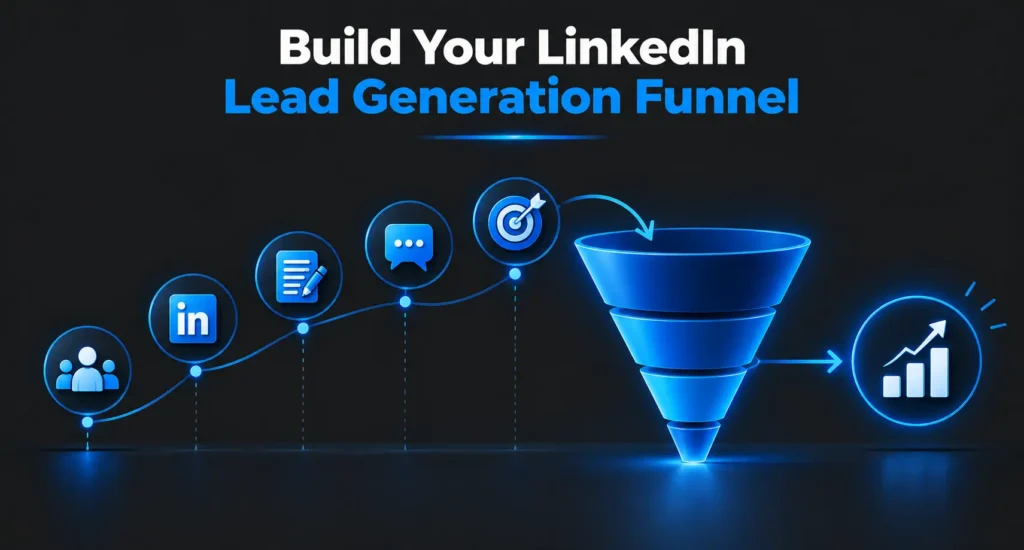
Each step of your LinkedIn lead generation funnel connects targeting, content, outreach, lead capture, nurturing, qualification, and measurement to create a more focused LinkedIn marketing strategy.
Step 1: Define Your Ideal Customer
A funnel cannot fix the wrong audience. Before creating content, sending LinkedIn outreach, or running LinkedIn Ads, define who you want to attract. A clear audience keeps your LinkedIn lead generation strategy focused and relevant.
Build Your Ideal Customer Profile
Your ICP should identify the businesses and decision-makers most likely to need your product or service.
- Industry and company size: Define the industries and business sizes that are the strongest fit for your offering.
- Job title and seniority: Identify the roles and decision-makers involved in the problem and purchasing process.
- Location and business model: Specify the markets and business types your sales and service teams can support.
- Common problems: Identify the recurring challenges that create a genuine need for your product or service.
- Buying authority and triggers: Identify who influences purchases and which business events can create immediate demand.
Identify Their Pain Points and Buying Signals
Your ICP tells you who to target. Pain points and intent signals help you understand what they need and when they may be ready to engage.
- Pain points and questions: Identify the problems and questions your ideal customers are actively trying to address.
- Relevant LinkedIn activity: Look for posts, comments, and engagement around problems related to your offering.
- Company changes: Monitor hiring, expansion, funding, leadership changes, and other events that can create new needs.
- Content and website interactions: Where tracking is available, use relevant content engagement and website activity as additional intent signals.
- Buying intent: Prioritize prospects showing multiple relevant signals rather than simply increasing your LinkedIn outreach volume.
Tip: Make Your ICP Specific Enough to Guide Your Content If your ICP is simply “B2B decision-makers,” it is too broad to guide effective LinkedIn marketing. Add details such as industry, company size, job role, common business problems, and buying triggers. Your ICP should make it easier to decide who your content is for, which prospects deserve outreach, and which leads should move further into the funnel. |
Step 2: Optimize Your LinkedIn Profile for Lead Generation
Your LinkedIn profile is often the page a prospect checks before deciding whether to reply. It should quickly explain who you help, what problem you solve, and why a prospect should trust your expertise.
Improve Your Headline and About Section
Your headline and About section should speak to your target buyer instead of simply listing your role, company, or professional title.
- Target audience: Clearly state who you help so relevant prospects can quickly identify your expertise.
- Problem and value: Explain the business problem you address and the practical value your expertise provides.
- Relevant expertise: Highlight experience and knowledge that directly relate to your ideal customer’s needs.
- Buyer-focused messaging: Use language that reflects the problems, priorities, and outcomes your target audience understands.
- Clear next step: Give interested visitors a simple way to learn more, contact you, or start a conversation.
Add Proof and Trust Signals
A strong profile should give prospects enough evidence to understand your experience before they receive a sales message or consider your offer.
- Case studies and results: Show relevant customer work and measurable outcomes when accurate results are available.
- Testimonials: Include genuine customer feedback that supports your expertise and addresses relevant buyer concerns.
- Experience: Highlight roles, projects, and industry experience that strengthen your professional positioning.
- Credentials: Include relevant certifications, awards, publications, or qualifications that support your expertise.
- Featured content: Use case studies, research, guides, webinars, or useful posts to provide additional proof and context.
Is Your Profile Losing Potential Leads? If prospects visit your profile but do not take action, Marvels Reach can help strengthen your positioning, messaging, and LinkedIn profile. |
Step 3: Create Content That Attracts Potential Buyers
Your LinkedIn content should do more than earn likes. It should make the right person recognize a problem they are already facing. Build your LinkedIn content strategy around the problems, questions, and priorities of your ideal customers. Focus on useful information that helps prospects understand a problem or evaluate their options.
- Pain points: Address specific problems your ideal customers face in their daily business.
- Questions and mistakes: Answer common questions and explain mistakes related to those problems.
- How-to advice: Share practical steps prospects can use to address relevant challenges.
- Insights and data: Use useful data, observations, and industry insights to support your points.
- Case studies and experiences: Show real examples, results, and lessons that relate to your target buyers.
Match Content to Different Funnel Stages
Use different content based on where prospects are in the LinkedIn lead generation funnel. Early content builds awareness, while later content addresses buying concerns, demonstrates expertise, and encourages action.
Funnel Stage | Content Purpose | Example |
Awareness | Help prospects recognize a problem | Industry insight |
Consideration | Help prospects understand possible approaches | How-to post |
Trust | Demonstrate expertise and results | Case study |
Conversion | Give interested prospects a reason to act | Consultation, demo, or resource |
Getting Engagement but No Leads? Marvels Reach can help connect your audience, content, and conversion path to turn relevant engagement into real opportunities. |
Step 4: Turn Engagement Into Conversations
A like is not a lead. A comment is not automatically a sales opportunity. Engagement becomes useful when it helps identify people who fit your ICP and show interest in a problem your business can solve. Use these signals to prioritize conversations instead of contacting everyone.
- Repeated engagement: Prioritize people who consistently interact with your posts or content around relevant business problems.
- Relevant questions: Pay attention to prospects asking questions that relate directly to your expertise or services.
- ICP fit: Check whether the person, company, role, and business need match your ideal customer profile.
- Context before outreach: Reference the interaction or relevant topic so your message has a clear reason for starting.
- Helpful conversation: Ask relevant questions, share useful information, and understand the prospect’s situation before discussing your offer.
Avoid turning every accepted connection into an immediate sales pitch. The goal is to start a relevant conversation and determine whether there is a genuine business need.
Step 5: Create a Lead Magnet or Offer
A LinkedIn lead generation funnel needs a clear conversion point. Give prospects something useful that directly addresses a problem they care about and provides a reason to take the next step.
Common lead magnet and offer options include:
- Industry reports: Provide research, trends, or data that helps prospects understand their market.
- Checklists and templates: Give prospects practical resources they can use to handle a specific task.
- Calculators: Help prospects estimate costs, returns, savings, or other relevant business factors.
- Audits: Review a relevant area of the prospect’s business and identify potential gaps or opportunities.
- Guides and webinars: Provide useful information that helps prospects understand or address a specific challenge.
- Consultations: Give qualified prospects an opportunity to discuss their situation and potential next steps.
Match the Offer to the Buyer’s Problem
Your offer should connect directly to the problems identified during your ICP research and content strategy.
Ask:
“Why would my ideal customer give me their information for this?”
If the answer is unclear, the offer probably needs to be more relevant to the buyer’s current problem. Avoid creating a generic ebook or resource simply because a lead magnet is expected in the funnel.
Tip: Test Your Offer Before Promoting It Before adding an offer to your LinkedIn funnel, ask whether it solves a problem your ideal customer already cares about. Check if the topic connects with your content, if the value is clear without a long explanation, and if the next step makes sense after someone receives it. A relevant offer gives prospects a stronger reason to continue. |
Step 6: Use LinkedIn Ads and Lead Gen Forms
LinkedIn Ads can support your LinkedIn lead generation strategy when your audience, offer, messaging, and follow-up process are already clear. They should support the funnel, not replace the work it needs.
When LinkedIn Ads Make Sense
Paid campaigns work best when the basic parts of your funnel are already defined. Clear targeting, relevant offers, strong landing pages, and follow-up processes help turn ad clicks into qualified leads.
- Clear ICP: Know which industries, companies, roles, and decision-makers you want your campaigns to reach.
- Strong offer: Give prospects a relevant reason to click, submit their information, or take another action.
- Relevant messaging: Make sure your ad speaks directly to the problem your target audience wants to solve.
- Conversion path: Decide what happens after someone clicks or submits a form, including the next marketing or sales step.
- Follow-up process: Have a clear process for responding to and qualifying new leads while their interest is still relevant.
Keep Lead Gen Forms Simple
LinkedIn Lead Gen Forms can pre-fill member information, reducing the amount prospects need to enter manually. LinkedIn recommends considering three to four fields and notes that fewer fields can improve the member experience. Collect only the information your team actually needs to follow up and qualify the lead.
Match the Ad, Offer and Form
The message should remain consistent throughout the conversion process. When the ad, offer, and form communicate the same value, prospects know exactly what they will receive after clicking and submitting their information.
- Ad: Get more qualified B2B leads
- Offer: B2B Lead Generation Checklist
- Form: Download the B2B Lead Generation Checklist
Do not use ads to hide a broken funnel. If your targeting, message, offer, or follow-up process is weak, increasing your ad budget does not automatically fix those problems.
Spending on Ads Without Results? If your funnel is not ready, increasing ad spend can simply increase wasted traffic and leads. Marvels Reach can help align your LinkedIn Ads, targeting, offer, and lead capture before you increase your ad spend. |
Step 7: Nurture and Qualify Your Leads
Not every LinkedIn lead is ready to book a meeting. Nurture interested prospects with relevant information, then qualify them before moving the conversation to sales.
Nurture Leads Before the Sales Conversation
Use relevant content and follow-ups to keep prospects engaged while they evaluate their needs and options.
- Educational content: Share information that helps prospects understand or address the problem they are dealing with.
- Case studies: Show relevant customer situations and results to provide practical proof of your expertise.
- Expert insights: Share useful perspectives that help prospects evaluate their problem or potential approaches.
- Relevant follow-ups: Continue the conversation with information connected to the prospect’s stated needs or interests.
- Useful resources: Send guides, research, checklists, or other resources that support the prospect’s decision-making process.
Qualify Leads Based on Fit and Intent
Lead volume alone does not show whether your LinkedIn lead generation funnel is producing useful opportunities. Qualify leads based on their business fit, need, and readiness.
- Fit: Does the prospect match your ICP, including industry, company, role, and business model?
- Need: Does the prospect have a problem your product or service can address?
- Intent: Has the prospect shown actions that indicate genuine interest or buying intent?
- Timing: Is the prospect considering a solution now, later, or with no current plans?
- Next step: Based on these factors, determine whether the lead needs more nurturing or is ready for a sales conversation.
Getting Leads but Losing Momentum? A lead still needs timely follow-up and qualification to become a real sales opportunity. Marvels Reach can help structure lead follow-up and qualification so promising prospects do not get lost after conversion. |
Step 8: Track the Metrics That Matter
If you only track likes and followers, you may be measuring activity instead of lead generation. Track metrics at each funnel stage to see where prospects engage, convert, or drop off.
Measure Engagement and Lead Generation
Track metrics based on what you want each stage of the LinkedIn lead generation funnel to achieve. Focus on meaningful engagement, conversations, qualified leads, and pipeline progress rather than surface-level activity alone.
- Visibility: Track impressions, reach, profile views, and relevant follower growth to measure audience exposure.
- Engagement: Monitor reactions, comments, shares, and engagement from people who match your target audience.
- Conversations: Track connection acceptance, replies, content clicks, and meaningful conversations with relevant prospects.
- Leads: Measure form submissions, inquiries, and other actions that indicate a prospect has entered your lead pipeline.
Track Qualified Leads, Meetings, and Pipeline
Lead volume does not show the full performance of your LinkedIn marketing strategy. Connect LinkedIn activity with sales outcomes to understand lead quality.
- Qualified leads: Measure how many leads match your ICP and show a relevant business need.
- Meetings: Track how many qualified leads move into sales meetings or consultations.
- Opportunities: Measure leads that progress into genuine sales opportunities.
- Pipeline: Track the potential revenue associated with LinkedIn-generated opportunities.
- Revenue: Where attribution is available, measure revenue generated from LinkedIn leads and opportunities.
Common LinkedIn Lead Generation Funnel Mistakes
A LinkedIn lead generation funnel can lose potential customers even when your business is posting consistently and generating engagement. These mistakes can create gaps between attention, conversations, and qualified opportunities.
- Posting without knowing who you want to attract: Content without a defined audience can generate engagement from people who are unlikely to become customers.
- Treating every connection like a lead: A connection is not automatically a sales opportunity. Focus on ICP fit and relevant buying signals.
- Pitching before building context: Start by understanding the prospect and their situation before introducing your product, service, or sales offer.
- Sending the same message to everyone: Generic outreach ignores differences in industry, role, business needs, and individual prospect context.
- Creating content that gets engagement from the wrong audience: High engagement has limited value when most interactions come from people outside your target market.
- Sending traffic to a weak landing page or offer: Keep your LinkedIn content, ad, landing page, offer, and CTA consistent with the same buyer need.
- Collecting leads without a follow-up process: Define who contacts new leads, how quickly they respond, and how leads move through the sales process.
- Measuring likes instead of qualified opportunities: Track qualified leads, meetings, opportunities, pipeline, and revenue instead of relying only on engagement metrics.
- Using AI to produce generic LinkedIn content: Use AI for research or drafting, but add real experience, specific examples, original insights, and human judgment.
LinkedIn Lead Generation Funnel: Do This, Not That
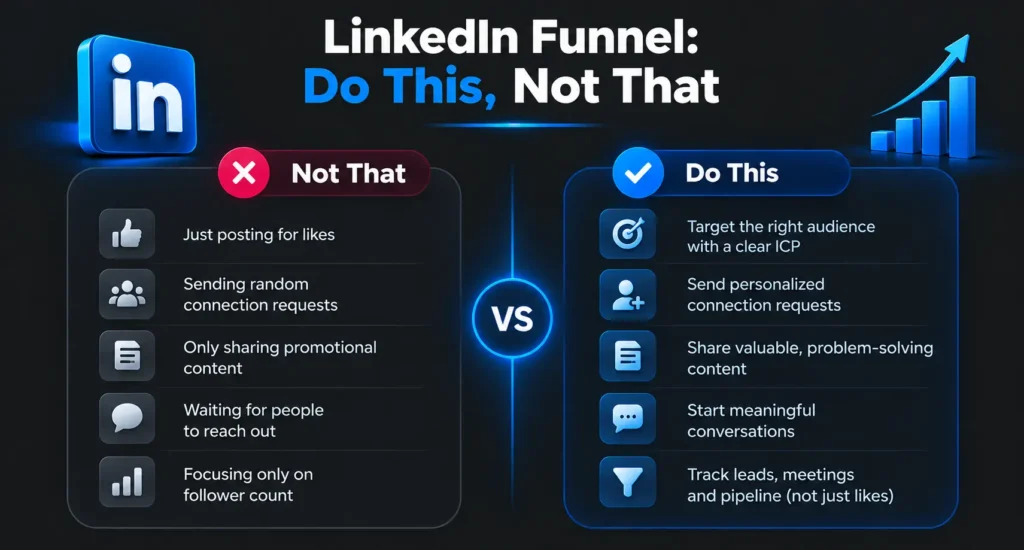
A strong LinkedIn lead generation strategy depends on making the right changes at each stage of the funnel. Use these comparisons to avoid common mistakes and keep your LinkedIn marketing focused on qualified opportunities.
Instead of | Do This | Why It Matters |
Posting for everyone | Create content for a defined ICP | Specific content is more relevant to the people most likely to need your product or service. |
Chasing connection numbers | Build relevant connections | A smaller network of relevant decision-makers can be more useful than a large network with little buying potential. |
Pitching immediately | Start with context | Understanding the prospect’s situation creates a more relevant reason for starting a sales conversation. |
Sending generic messages | Personalize around real relevance | Referencing the prospect’s role, business situation, content, or potential need makes outreach more meaningful. |
Measuring likes | Measure qualified leads and pipeline | Engagement shows activity, while qualified leads and pipeline show whether LinkedIn is contributing to business opportunities. |
Buying ads before testing | Validate the funnel first | Testing the audience, message, offer, and follow-up process can identify problems before you increase paid traffic. |
Automating every interaction | Use automation carefully while keeping communication human | Automation can reduce repetitive work, but overly automated messages can remove context and make conversations feel impersonal. |
Creating content only for awareness | Build content for multiple funnel stages | Prospects need different information as they move from recognizing a problem to considering and evaluating an option. |
Treating every lead equally | Prioritize fit and buying intent | Qualification helps sales teams spend time on prospects with a relevant need and stronger potential to move forward. |
Collecting leads and stopping there | Create a clear follow-up process | A captured lead still needs timely follow-up, nurturing, qualification, and a defined next step. |
When Managing LinkedIn Marketing Yourself Starts Becoming a Problem
At some point, LinkedIn stops being “just a few posts a week.” What starts as occasional posting can quickly become a long list of ongoing tasks:
- Audience research
- Profile optimization
- Content planning and copywriting
- Design and publishing
- Engagement management
- Prospect research and outreach
- Follow-ups and lead qualification
- LinkedIn Ads
- Performance reporting
The challenge is not managing one task. It is keeping all of these activities connected. Your content should reach the right audience. Your outreach should have context. Your lead generation should connect with follow-ups. When everything is handled internally, LinkedIn can become difficult to manage consistently alongside your regular marketing, sales, and business responsibilities.
The Problem Is Not That You Cannot Do It
Most businesses can handle parts of LinkedIn marketing themselves. The bigger challenge is finding enough time to manage every part consistently. You may know your audience, understand your industry, and have plenty of ideas for content. Turning that knowledge into a structured LinkedIn marketing process requires regular research, planning, execution, and follow-up.
As activity increases, gaps can also appear. Content may be published without a clear lead generation goal. Outreach may happen without enough prospect research. Leads may be collected without a defined qualification or follow-up process. A professional approach does not replace your knowledge of the business. It puts that knowledge into a structured process and takes much of the ongoing execution off your plate.
What Professional Support Adds to Your LinkedIn Lead Generation Funnel?
At some point, LinkedIn stops being “just a few posts a week.” Managing it effectively involves several connected activities, from audience research and content creation to prospect outreach, lead generation, and performance tracking. The challenge is keeping all of these activities aligned with your business goals.
At Marvels Reach, our team can manage the key parts of your LinkedIn marketing strategy while keeping them connected to one lead generation process:
- LinkedIn strategy: Define your audience, positioning, goals, and activities based on your broader marketing objectives.
- Content strategy: Plan topics around buyer problems, industry priorities, expertise, and different stages of the buying process.
- Personal branding: Build a consistent professional presence that reflects your expertise and business positioning.
- LinkedIn content: Create useful content that attracts and engages the people you want to reach.
- Outreach and engagement: Research relevant prospects, manage conversations, and use context instead of generic sales messages.
- Lead generation: Connect content, outreach, offers, and conversion points to create relevant business opportunities.
- LinkedIn Ads: Manage paid campaigns around defined audiences, offers, lead capture, and measurable objectives.
- Lead qualification and follow-up: Assess leads based on fit, need, intent, and timing while keeping interested prospects moving forward.
- Performance tracking: Monitor conversations, leads, qualified opportunities, meetings, and pipeline to understand what contributes to business results.
The goal is not simply to outsource individual LinkedIn tasks. It is to have one connected process where audience research informs content, content supports outreach, outreach creates conversations, and qualified leads move toward sales opportunities. This reduces the day-to-day workload while giving your LinkedIn activity a clearer direction.
Turn LinkedIn Activity Into Qualified Leads
A strong LinkedIn presence is not defined by how often your business posts or how many connections it has. The real value comes from creating a consistent path that helps the right prospects move from initial interest toward a business conversation. Your LinkedIn lead generation funnel should give every activity a purpose, while leaving enough room to adapt as you learn what resonates with your market. When the process is clear, your team can spend less time guessing what to do next and more time acting on meaningful opportunities.
If your LinkedIn efforts are generating activity but not enough business conversations, Marvels Reach can help you build a more focused LinkedIn lead generation strategy. Contact Marvels Reach team to discuss your goals and create a LinkedIn funnel that supports your sales process.