Key Takeaways
● LinkedIn marketing needs a clear strategy connecting the right audience, useful content, conversations, and lead generation. ● Define your ICP before creating content to reach the right decision-makers with relevant messaging. ● Create content that solves real problems instead of constantly promoting your products or services. ● Turn connections into conversations through personalized outreach, consistent engagement, and understanding prospect needs. ● Get professional support when needed to manage content, personal branding, outreach, and LinkedIn Ads more effectively. |
You’re posting on LinkedIn, getting a few likes and impressions, but still wondering, “Where are the leads?” For many startups, LinkedIn marketing starts with good intentions but quickly turns into random posts, low engagement, unanswered connection requests, and very few sales conversations.
The problem is often not LinkedIn itself. It’s the lack of a clear LinkedIn marketing strategy for startups. Without the right audience, content strategy, personal branding, and LinkedIn lead generation approach, even consistent posting can struggle to deliver real business results.
In this practical guide, we’ll break down how startups can build a LinkedIn lead generation strategy-from finding the right audience and creating content to LinkedIn outreach, building trust, and converting conversations into qualified leads.
What is LinkedIn marketing for startups? LinkedIn marketing for startups is the process of using LinkedIn content, personal branding, networking, outreach, and paid campaigns to build credibility, reach the right audience, and generate qualified business leads. |
Why LinkedIn Marketing Matters for Startups
For startups, LinkedIn is no longer just a place to share company updates. It can help you reach decision-makers, build trust, strengthen your brand, and generate qualified B2B leads-when you have the right strategy.
- Reach the Right Decision-Makers: LinkedIn allows startups to target professionals by factors such as job title, industry, company size, seniority, and location, making it easier to reach the people who actually influence buying decisions.
- Build Trust Before the Sales Pitch: Buyers often research a business before starting a conversation. Consistent LinkedIn content marketing, thought leadership, and founder-led content can help establish credibility before a sales call ever happens.
- Generate More Relevant B2B Leads: With the right LinkedIn lead generation strategy, startups can turn content, targeted outreach, and paid campaigns into meaningful conversations rather than chasing random connections.
- Build a Strong Founder and Brand Presence: A well-optimized company page combined with an active founder profile can make a startup easier to discover, understand, and trust. LinkedIn itself recommends an active, updated presence for startups looking to grow.
- Measure What Actually Drives Growth: Instead of focusing only on likes and followers, startups can track qualified leads, profile activity, engagement, conversions, and pipeline impact to understand what is actually working.
Why Most Startups Struggle With LinkedIn Marketing
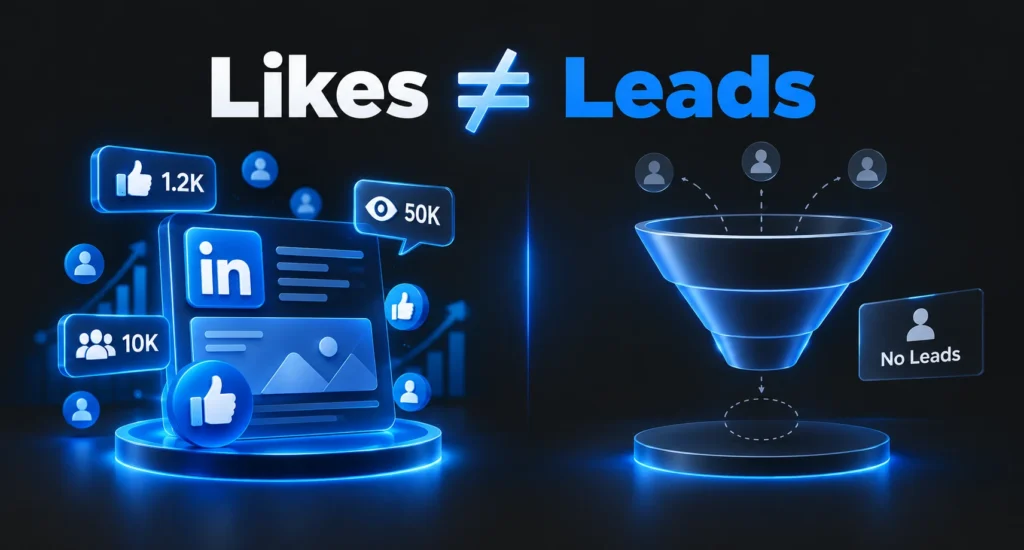
LinkedIn marketing sounds simple until you have to do it consistently. Many startups are putting in the effort but still struggle with content, engagement, outreach, and turning LinkedIn activity into qualified leads.
“We Post Regularly, But Nothing Happens”
You’re showing up on LinkedIn every week, but the numbers aren’t moving in the direction you expected. The problem may not be consistency-it may be what you’re posting, who you’re reaching, and why.
Pain Points
- Posts get impressions but very little meaningful engagement.
- Most likes come from existing connections instead of potential customers.
- Content feels generic and doesn’t address the audience’s real problems.
- There is no clear LinkedIn content strategy behind the posting schedule.
- You’re unsure which content actually contributes to LinkedIn lead generation.
- Weeks of posting still don’t result in meaningful sales conversations.
Solution
A strong LinkedIn marketing strategy for startups should connect every piece of content to a clear purpose. Instead of simply posting more, focus on audience-specific topics, strong hooks, useful insights, and content that naturally moves the right prospects from awareness to conversation.
“We Don’t Know What to Post on LinkedIn”
The blank-post screen can become surprisingly stressful. You know your business inside out, but turning that knowledge into engaging LinkedIn content every week is a completely different challenge.
Pain Points
- You keep asking, “What should we post on LinkedIn today?”
- Content ideas run out after a few weeks.
- Posts become repetitive or overly promotional.
- There are no defined LinkedIn content pillars.
- Industry topics are shared without adding an original point of view.
- Your content talks about your business more than your customer’s problems.
Solution
Start with the questions your target audience is already asking. A professional LinkedIn content strategy can turn customer pain points, industry trends, common mistakes, FAQs, case studies, and your team’s expertise into a consistent content calendar that educates rather than constantly sells.
“Our Founder Doesn’t Have Time to Manage LinkedIn”
Founders understand the value of personal branding on LinkedIn, but finding time to write posts, respond to comments, research topics, and engage with prospects can feel like another full-time responsibility.
Pain Points
- The founder has limited time for LinkedIn marketing.
- Posting becomes inconsistent during busy business periods.
- Valuable founder insights remain stuck in meetings and conversations.
- Writing content takes longer than expected.
- LinkedIn engagement and networking keep getting pushed back.
- The founder wants to build authority without sounding overly promotional.
Solution
Founder-led LinkedIn marketing doesn’t mean the founder has to do everything alone. A professional team can understand the founder’s expertise, experiences, opinions, and business goals and turn them into authentic posts, while keeping the founder’s voice and personality intact.
“We Are Getting Connections, But Not Leads”
Having hundreds or even thousands of LinkedIn connections can feel like progress. But if those connections aren’t turning into relevant conversations, your LinkedIn lead generation strategy needs a closer look.
Pain Points
- Connection requests are accepted but conversations don’t continue.
- Outreach messages sound too sales-focused.
- The same message is sent to different types of prospects.
- Prospects are approached without understanding their needs.
- There is too much focus on connection volume instead of connection quality.
- Follow-ups feel awkward or overly promotional.
- It’s difficult to identify which prospects are genuinely interested.
Solution
Effective LinkedIn outreach starts with relevance, not a sales pitch. By identifying the right prospects, personalizing communication, engaging with their content, and starting conversations around genuine business challenges, startups can build relationships that have a better chance of becoming qualified leads.
“Our LinkedIn Company Page Looks Active, But It Doesn’t Generate Business”
A professional-looking company page is important, but an active page alone doesn’t guarantee leads. If your LinkedIn presence isn’t connected to a broader strategy, your content may simply be getting seen without creating business opportunities.
Pain Points
- The company page has regular posts but limited engagement.
- Follower growth isn’t translating into leads.
- Content focuses heavily on company announcements and promotions.
- The founder’s personal profile is being underused.
- There is little connection between company page marketing and lead generation.
- Visitors can’t quickly understand what problem your startup solves.
- There is no clear path from LinkedIn content to a sales conversation.
Solution
Think beyond the company page. A stronger LinkedIn marketing strategy combines company content, founder personal branding, employee advocacy, thought leadership, targeted engagement, and lead generation. The goal isn’t simply to make the page look active-it is to create a LinkedIn presence that helps the right prospects discover, understand, and trust your business.
LinkedIn Marketing Strategy – The Core Steps
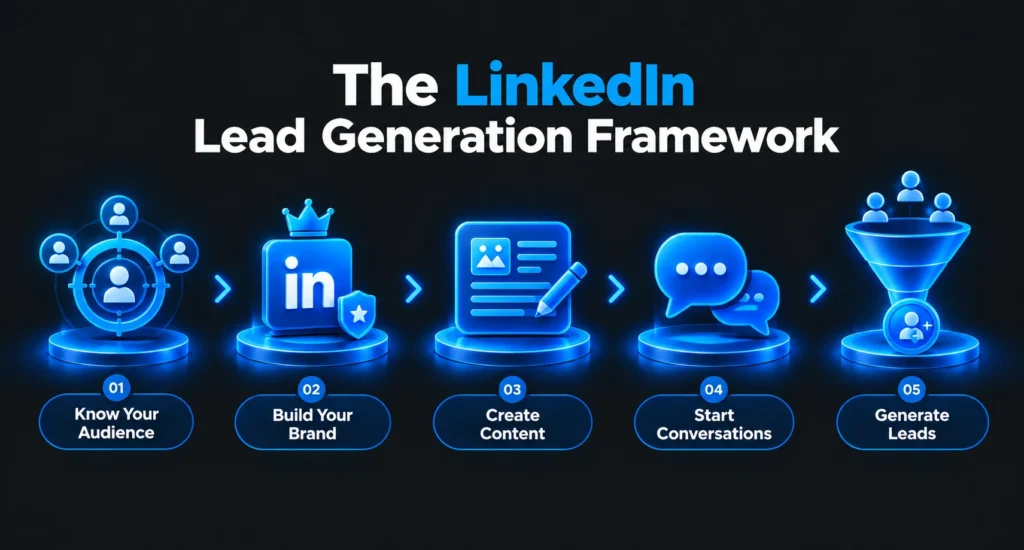
A successful LinkedIn marketing strategy for startups isn’t about posting more or sending more connection requests. It starts with knowing your audience, building trust, creating useful content, and turning attention into meaningful business conversations.
Start With the Most Important Question: Who Are You Trying to Reach?
Before thinking about posts, hashtags, or outreach, get clear about who you want as a customer. The more specific your audience, the easier it becomes to create relevant content and generate qualified LinkedIn leads.
Build Your Ideal Customer Profile (ICP)
Your Ideal Customer Profile (ICP) defines the type of company or buyer most likely to need your solution. Instead of targeting everyone on LinkedIn, identify the people who are most relevant to your business.
Consider:
- Industry and niche
- Company size
- Job title and seniority
- Location or target market
- Business goals
- Common challenges
- Buying power and decision-making role
A clear ICP also makes LinkedIn prospecting, outreach, content creation, and LinkedIn Ads targeting much more focused.
Understand Your Audience’s Pain Points
Knowing someone’s job title isn’t enough. You need to understand what keeps them stuck, what they are trying to achieve, and what problems they are actively looking to solve.
Look at customer questions, sales conversations, reviews, industry discussions, and common objections. These insights can become the foundation for your LinkedIn content strategy and help you create posts that feel relevant rather than promotional.
Optimize Your LinkedIn Profile Before You Start Generating Leads
Your LinkedIn profile is often the first place a prospect goes after seeing your content or receiving your message. If it doesn’t quickly communicate your expertise and value, you may lose an interested prospect before the conversation even starts.
LinkedIn Headline Optimization
Your headline shouldn’t simply say your job title or company name. Use it to explain who you help, what you help them achieve, and what makes your expertise relevant.
For example, instead of:
- Founder at XYZ
Consider:
- Helping B2B Startups Generate Qualified Leads Through LinkedIn Marketing
This makes your profile more relevant to both people and LinkedIn search.
About Section
Your About section should answer three simple questions:
- Who do you help?
- What problem do you solve?
- Why should someone trust you?
Keep the language conversational and focus more on the customer’s challenges than on a long list of achievements.
Featured Section
Use the Featured section to showcase content that helps prospects understand your expertise.
You can include:
- Case studies
- High-performing LinkedIn posts
- Guides and resources
- Client results
- Website or service pages
- Webinars or relevant videos
Think of it as a small proof and resource section on your LinkedIn profile.
Profile Banner
Don’t leave your LinkedIn banner as an afterthought. A simple, professionally designed banner can reinforce your brand positioning and value proposition the moment someone visits your profile.
Keep it clear, readable, and focused on one key message rather than filling the space with too much information.
Social Proof & Case Studies
Prospects want evidence, not just claims. Add relevant client results, testimonials, certifications, case studies, or industry experience wherever appropriate.
Instead of saying “We help businesses grow,” show what changed after working with you.
Clear Call-to-Action
Make it easy for an interested prospect to take the next step.
Your CTA could encourage them to:
- Visit your website
- Send you a message
- Download a resource
- Explore a case study
- Book a consultation
The goal isn’t to push every visitor into a sales call. It’s to give genuinely interested people a clear next step.
Build a LinkedIn Content Strategy That People Actually Want to Read
Good LinkedIn content doesn’t begin with “What can we sell today?” It begins with “What does our audience need to know, understand, or solve?” That’s the shift that makes content more useful and relatable.
Don’t Start With “What Can We Promote?”
If every post talks about your product, service, features, or achievements, your audience may quickly stop paying attention.
Instead, build content around:
- Customer problems
- Common questions
- Industry changes
- Practical advice
- Mistakes
- Lessons from experience
- Data and insights
- Real customer situations
Promotion should be part of your LinkedIn content strategy-not the entire strategy.
Use 5 Core LinkedIn Content Pillars
A simple content framework can help startups stay consistent without repeating the same ideas.
- Pain Points & Problems – Address challenges your ideal customers face.
- Educational Content – Share practical tips, processes, and how-to advice.
- Thought Leadership – Share opinions, observations, and original industry insights.
- Social Proof – Use case studies, customer stories, results, and lessons.
- Founder & Brand Stories – Show the people, experiences, and thinking behind the business.
Together, these pillars can create a balanced LinkedIn content marketing strategy that builds awareness, authority, and trust.
Some posts should help prospects discover a problem. Others should teach them something useful, challenge their thinking, demonstrate your expertise, or show how you’ve helped others.
This prevents your LinkedIn feed from becoming a constant sales pitch while still creating opportunities for LinkedIn lead generation.
Running out of LinkedIn content ideas or struggling to stay consistent? Marvels Reach can help turn your audience’s questions, pain points, and industry insights into a content strategy designed to build visibility and trust. Let’s build your LinkedIn content strategy. |
What Should Startups Post on LinkedIn to Generate Leads?
There is no single “perfect” LinkedIn post format. The best content is content that makes the right person stop, think, learn something, or see their own problem differently.
Problem-Solution Posts
Start with a problem your target customer already understands, then provide a practical solution.
For example:
- “Your LinkedIn posts aren’t generating leads-not because your audience is wrong, but because your content isn’t addressing their buying problem.”
These posts work well because they immediately connect with a customer pain point.
Founder Stories
People connect with experiences more easily than corporate statements.
Share:
- Lessons from building the startup
- Difficult decisions
- Customer experiences
- Failures and what they taught you
- Unexpected business lessons
- Milestones and turning points
Founder-led content can make your brand feel more human while strengthening personal branding on LinkedIn.
Industry Insights
Don’t just share industry news. Add your perspective.
Explain:
- What changed?
- Why does it matter?
- How could it affect your audience?
- What should businesses do next?
This helps position your startup as a business that understands its industry-not just one that follows it.
Customer Lessons
Turn customer experiences into useful learning.
Instead of only saying “We helped Client X achieve Y,” explain what the situation taught you and what other businesses can learn from it.
This combines storytelling, expertise, and social proof without making the post feel like an advertisement.
Case Studies
Case studies provide something many promotional posts lack: evidence.
A simple structure is:
Challenge – Approach – Action – Result – Lesson
Where possible, use meaningful numbers and specific outcomes to make your LinkedIn lead generation content more credible.
Mistakes & Lessons Learned
Nobody wants to read another post saying everything went perfectly.
Share mistakes your team made, what caused them, what you changed, and what others can learn from the experience.
Authentic lessons can create stronger engagement than polished promotional messages.
Data-Driven Posts
Numbers can make an idea easier to understand and more credible.
You can share:
- Industry statistics
- Customer insights
- Campaign results
- Survey findings
- Performance trends
- Original research
Always explain why the data matters instead of simply dropping a statistic into a post.
Opinion / Contrarian Posts
If everyone in your industry is saying the same thing, a thoughtful alternative perspective can make people stop scrolling.
For example:
- “More LinkedIn connections don’t always mean more leads.”
Back your opinion with experience, examples, or evidence. The goal isn’t to be controversial for attention-it’s to offer a perspective worth discussing.
Behind-the-Scenes Content
Show what happens beyond the polished company website.
You can share:
- Team moments
- How you solve customer problems
- Campaign planning
- Content creation
- Product development
- Lessons from meetings or projects
This type of content can help prospects understand the people and process behind your brand.
Product Content – Without Sounding Like an Advertisement
You don’t have to avoid promoting your product or service. The key is to connect the product to a real problem.
Instead of:
- “Our platform has 20 new features.”
Try:
- “We built this feature because our customers were spending hours solving this problem manually.”
Show the problem, the reason behind the solution, and the outcome. That’s product marketing people can actually relate to.
Still posting on LinkedIn without seeing meaningful leads? You may not need more content-you may need a strategy built around your audience, goals, and buying journey. Explore how Marvels Reach can help you build a tailored LinkedIn marketing strategy. |
How to Write LinkedIn Posts That Stop the Scroll
On LinkedIn, you don’t get much time to earn someone’s attention. A strong hook, simple language, one clear idea, and a natural CTA can turn an ordinary post into content that gets read, remembered, and acted on.
Your First Line Matters
The first line is your scroll-stopper. If it doesn’t make your target audience curious or help them recognize a problem, they may never read the rest of your LinkedIn post.
Try hooks that speak directly to your audience’s pain points:
- “You’re posting on LinkedIn every week. So why aren’t the leads coming?”
- “Most startups don’t have a LinkedIn lead generation problem. They have a targeting problem.”
- “Your LinkedIn profile may be costing you potential leads.”
- “Getting LinkedIn impressions feels good. Getting qualified leads feels better.”
- “We thought posting more would generate more leads. It didn’t.”
A good LinkedIn content strategy isn’t about creating clickbait. Your opening line should create curiosity while staying connected to the actual value of the post.
Keep the Language Simple
You don’t need complicated words to sound like an expert. In fact, simple, conversational LinkedIn content is often easier for busy decision-makers to understand and remember.
When writing LinkedIn posts:
- Use short sentences and paragraphs.
- Write the way you would speak to a potential customer.
- Avoid unnecessary marketing jargon.
- Explain complex ideas with simple examples.
- Focus on the reader’s problem rather than your company’s features.
- Use relevant LinkedIn keywords and industry terms naturally.
The goal is simple: make your expertise easy to understand without making it sound generic.
One Post = One Clear Idea
Trying to explain five things in one LinkedIn post usually makes the message harder to follow. Pick one problem, one insight, or one lesson and build the entire post around it.
For example, instead of writing:
- “5 ways to improve your LinkedIn profile, content, outreach, personal branding, and ads.”
Create separate posts around:
- How to optimize your LinkedIn headline
- Why your LinkedIn content isn’t generating leads
- How founders can build a personal brand
- Why generic LinkedIn outreach doesn’t work
- When startups should consider LinkedIn Ads
This makes your LinkedIn content marketing strategy easier to manage and gives each post a stronger purpose.
End With a Natural CTA
A CTA doesn’t always have to be “Book a call now.” If you’ve spent the post helping your audience, the next step should feel like a natural continuation of the conversation.
Depending on the post, you can use CTAs such as:
- “Have you faced the same challenge?”
- “What has worked for your startup?”
- “Would you add anything to this list?”
- “Save this for your next LinkedIn content planning session.”
- “Want to see how this could work for your business? Let’s talk.”
For LinkedIn lead generation, match your CTA to the reader’s level of interest. Sometimes a comment or follow is the right next step; sometimes it’s a DM, resource download, or sales conversation. The goal is to start a relationship, not force a sale.
LinkedIn Lead Generation: Turn Attention Into Conversations
Getting attention on LinkedIn is only the beginning. The real opportunity comes when that attention turns into conversations with the right people. A strong LinkedIn lead generation strategy connects content, outreach, personalization, and genuine relationship-building.
Use Content to Create Inbound Leads
Your content can do the first part of the sales conversation before you ever speak to a prospect. When your LinkedIn content strategy consistently addresses real customer problems, the right people can discover your expertise and start engaging with your brand.
Focus on creating content that:
- Answers common customer questions
- Solves specific industry problems
- Shares useful insights and practical advice
- Demonstrates your expertise
- Addresses common buying objections
- Shows real experiences and results
The goal isn’t to make every post sell your service. Useful content builds familiarity and trust, making it easier for potential customers to reach out when they are ready.
Use Strategic Outreach to Create Outbound Opportunities
Inbound leads are valuable, but startups don’t always have to wait for prospects to find them. LinkedIn outreach and social selling can help you proactively connect with people who fit your Ideal Customer Profile (ICP).
Start by identifying relevant prospects based on:
- Job role and seniority
- Industry
- Company size
- Location
- Business needs
- Relevant professional activity
Then engage with the right people before moving toward a sales conversation. Strategic LinkedIn prospecting is less about sending hundreds of messages and more about reaching the right people with the right context.
Personalize Connection Requests
A generic “I’d love to connect” message doesn’t give a prospect much reason to accept. Personalization makes your LinkedIn connection request relevant and shows that you have taken a moment to understand who you’re reaching out to.
You can personalize based on:
- A recent post they shared
- Their role or company
- A common industry challenge
- A recent achievement
- A relevant mutual connection
- Something genuinely useful you can discuss
Keep it short and natural. Personalized LinkedIn outreach should sound like the beginning of a professional conversation-not the opening line of a sales script.
Don’t Pitch Immediately After Someone Accepts
A connection acceptance is not a buying signal. Sending a sales pitch seconds after someone accepts your request can make the conversation feel transactional before any trust has been built.
Instead:
- Thank them for connecting.
- Look for a genuine reason to continue the conversation.
- Engage with relevant content when appropriate.
- Understand their challenges.
- Introduce your solution only when there is a relevant opportunity.
This relationship-first approach to LinkedIn lead generation can create more meaningful conversations than aggressive outreach.
Start Conversations Around Their Problem
The best LinkedIn sales conversations don’t begin with “Here’s what we offer.” They begin with “Are you facing this problem too?”
If you know your ICP and understand its pain points, your outreach can focus on challenges such as:
- Difficulty generating qualified B2B leads
- Low LinkedIn engagement
- Inconsistent content
- Poor conversion from LinkedIn traffic
- Lack of founder visibility
- Ineffective LinkedIn outreach
- Difficulty measuring LinkedIn marketing ROI
Once the prospect recognizes the problem, your expertise becomes more relevant. That’s where social selling, personalized LinkedIn outreach, and professional lead generation services can work together to move a simple connection toward a genuine business conversation.
Getting LinkedIn connections but not enough conversations? Your outreach may need better targeting, personalization, and timing. Marvels Reach helps businesses build LinkedIn outreach and lead-generation strategies focused on relevant prospects-not random connection numbers. Turn more conversations into opportunities. |
LinkedIn Outreach vs. Spam: Know the Difference
There’s a big difference between reaching out to the right prospect and filling their inbox with sales pitches. Effective LinkedIn outreach starts conversations; spam tries to force them. Knowing the difference can make your LinkedIn lead generation far more effective.
| LinkedIn Outreach | Spam Outreach |
| Starts with relevance- The message has a genuine reason for contacting the prospect. | Starts with a pitch- The prospect immediately receives a product or service offer. |
| Targets the right audience- Prospects match your Ideal Customer Profile (ICP). | Targets everyone- Messages are sent to large lists without checking relevance. |
| Personalized messaging- The message considers the person’s role, company, content, or business situation. | Copy-paste messaging- The same message is sent to hundreds of connections. |
| Problem-first approach- The conversation focuses on a challenge the prospect may actually face. | Product-first approach- The message focuses on features, packages, or services. |
| Builds relationships- The goal is to start a meaningful professional conversation. | Chases quick conversions- The goal is to get an immediate reply, call, or sale. |
| Natural follow-ups- Follow-ups add context, value, or a relevant question. | Repeated follow-ups- Multiple “Just checking in” messages are sent without adding value. |
| Respects the prospect’s time- Messages are short, clear, and relevant. | Overloaded messages- Long paragraphs explain everything about the company at once. |
| Uses social selling- Engagement and conversations happen before or alongside the sales approach. | Uses aggressive selling- The prospect is pushed toward a demo or meeting immediately. |
| Relevant CTA- The next step matches the prospect’s level of interest. | Hard CTA- “Book a call now” appears before any real conversation has happened. |
| Focuses on quality- A smaller number of relevant conversations can be more valuable. | Focuses on volume- Success is measured by how many messages are sent. |
| Uses genuine personalization- Personalization is based on real information and context. | Uses fake personalization- First names or company names are inserted into an otherwise generic template. |
| Learns from responses- Conversations help improve messaging and understand customer needs. | Ignores feedback- The same script continues even when prospects don’t respond. |
| Supports long-term lead generation- Relationships can develop into opportunities over time. | Creates short-term pressure- The approach can damage trust and brand perception. |
| Feels human- The message sounds like something a real professional would naturally say. | Feels automated- The message sounds robotic, repetitive, or overly promotional. |
| Success = meaningful conversations and qualified leads- The focus is on business outcomes. | Success = messages and connections- High activity is mistaken for effective LinkedIn lead generation. |
Should Startups Use LinkedIn Ads for Lead Generation?
LinkedIn Ads can put your startup in front of the right decision-makers, but paid promotion isn’t a shortcut to a weak marketing strategy. The real question is whether your audience, offer, content, and conversion process are ready for paid LinkedIn lead generation.
When LinkedIn Ads Can Help
LinkedIn advertising can be effective when a startup already knows who it wants to reach and what it wants that audience to do. Paid campaigns can help expand reach, generate leads, promote valuable content, and reach specific B2B audiences.
LinkedIn Ads may make sense when you have:
- A clearly defined Ideal Customer Profile (ICP)
- A specific target audience and decision-makers
- A proven product or service
- A clear value proposition
- A strong landing page or conversion experience
- A relevant lead magnet, offer, or demo
- Content or creative that has already shown audience interest
- A defined B2B lead generation strategy
- A process for following up with incoming leads
For startups, the goal should not simply be to get more clicks. It should be to generate qualified leads that have a realistic chance of becoming customers.
When You Should Not Rush Into LinkedIn Ads
Paid LinkedIn marketing cannot fix unclear positioning or weak messaging. If you don’t know who you’re targeting or why they should care about your offer, spending more on ads can simply make an ineffective strategy more expensive.
Consider fixing these areas first:
- You don’t have a clear ICP.
- Your offer isn’t clearly defined.
- Your LinkedIn profile and company page lack credibility.
- Your content isn’t generating any meaningful engagement.
- You don’t know which customer pain points to address.
- Your landing page isn’t optimized for conversions.
- There is no lead follow-up process.
- You’re expecting immediate sales from cold audiences.
Start with organic LinkedIn marketing, content testing, and audience research. Once you understand what resonates, you can use paid campaigns to scale what is already working.
LinkedIn Lead Gen Forms
LinkedIn Lead Gen Forms allow prospects to submit their information directly within LinkedIn instead of manually filling out a separate landing page form.
This can reduce friction in your LinkedIn lead generation campaigns, particularly when you’re promoting:
- Ebooks and guides
- Webinars
- Reports
- Free consultations
- Demo requests
- Industry resources
- Other valuable lead magnets
The important part is what happens after the form is submitted. A lead is only useful when your team can qualify, follow up, and move the conversation forward.
Sponsored Content
Sponsored Content helps startups put their posts and marketing messages in front of a targeted LinkedIn audience beyond their existing followers.
Rather than promoting every post, focus on content that already provides value, such as:
- Industry insights
- Research and reports
- Customer success stories
- Educational content
- Thought leadership
- High-value resources
This makes paid content feel less like “Buy our service” and more like “Here’s something useful for the problem you’re trying to solve.”
Retargeting
Not everyone who visits your website, watches your video, or interacts with your LinkedIn content is ready to become a customer immediately.
LinkedIn retargeting helps startups reconnect with people who have already shown some level of interest in their brand or content.
For example, you can create campaigns around audiences who have:
- Visited your website
- Engaged with your LinkedIn content
- Watched your video
- Interacted with previous campaigns
Retargeting works particularly well as part of a broader B2B LinkedIn marketing strategy, because the audience already has some awareness of your brand.
Account-Based Marketing (ABM)
If your startup sells to a smaller number of high-value companies, Account-Based Marketing (ABM) can be more useful than trying to reach a broad audience.
With LinkedIn ABM, you can focus your marketing efforts on specific target accounts and decision-makers rather than treating every potential customer the same.
A simple ABM approach can look like:
Identify target accounts – Find decision-makers – Create relevant content – Run targeted campaigns – Engage – Start conversations – Measure pipeline
The key is alignment. Your LinkedIn Ads, content marketing, sales outreach, and follow-up strategy should work together rather than operate as separate activities.
How AI Is Changing LinkedIn Marketing in 2026
AI is changing how startups research, create, personalize, and measure LinkedIn marketing. But the biggest opportunity isn’t replacing people with AI-it’s using AI to save time while keeping strategy, expertise, and human connection at the centre.
- AI-Assisted Content Research: AI can help identify trending topics, recurring customer questions, content gaps, and industry conversations, giving startups more ideas for their LinkedIn content strategy.
- Faster Content Ideation: Instead of staring at a blank screen, teams can use AI to turn customer pain points, FAQs, and industry trends into potential LinkedIn post ideas.
- Content Repurposing: A single case study, webinar, blog, or customer conversation can be transformed into multiple LinkedIn posts, helping startups maintain consistent LinkedIn content marketing.
- Personalized LinkedIn Outreach: AI can help research prospects and identify relevant context for outreach. However, personalization should be based on genuine information-not simply adding someone’s first name to a template.
- Better Audience Research: AI tools can help organize information about your Ideal Customer Profile (ICP), identify common challenges, and uncover patterns that can improve your LinkedIn lead generation strategy.
- Performance Analysis: Instead of looking only at likes and impressions, AI can help identify which topics, formats, hooks, and audiences are generating stronger engagement and potential B2B leads.
- Smarter Content Optimization: AI can assist with headlines, hooks, content structure, readability, and keyword placement while helping marketers keep content aligned with SEO, AEO, and GEO considerations.
Don’t Let AI Make Your LinkedIn Content Sound Like AI
AI can help you create content faster. It shouldn’t make your content sound like everyone else’s. Use AI for research, ideas, and efficiency-but add real experiences, original opinions, customer insights, and your own voice.
| Tip: The best LinkedIn content in 2026 won’t be the content that uses the most AI. It will be the content that uses AI without losing the human behind it. |
Personal Branding: Why Founders Matter More Than a Company Page
A company page tells people what your startup does. A strong founder profile can show them why they should trust you. In 2026, founder-led content and personal branding can become powerful parts of a startup’s LinkedIn marketing strategy.
- People Connect With People: Founder-led content makes your startup feel more human, relatable, and easier to connect with than corporate updates alone.
- Build Trust Before the Sales Conversation: A strong LinkedIn profile and consistent content can build credibility before a prospect ever enters a sales conversation.
- Turn Expertise Into Thought Leadership: Share industry knowledge, customer insights, and real experiences to position the founder as a trusted industry voice.
- Create More Opportunities for Organic Reach: Founder posts can expand your reach beyond company-page followers and create more opportunities for meaningful LinkedIn engagement.
- Make Your Brand Easier to Remember: A recognizable founder voice can make your startup easier to remember than a feed filled only with promotional content.
- Support LinkedIn Lead Generation: Strong personal branding can support social selling, LinkedIn prospecting, and lead generation by building familiarity and trust.
- Strengthen the Company Page: Combine the founder profile, company page, employee advocacy, and content strategy to create a stronger LinkedIn presence.
- Build Authority Beyond Your Product: Discuss customer problems, industry insights, and practical lessons instead of constantly promoting what your startup sells.
- Give Prospects a Reason to Start a Conversation: Relevant founder content gives prospects a natural reason to engage, comment, connect, or start a conversation.
- Let the Founder Stay Human: The best founder personal branding strategy combines professional expertise with real experiences, opinions, stories, and personality.
How to Measure LinkedIn Marketing Success
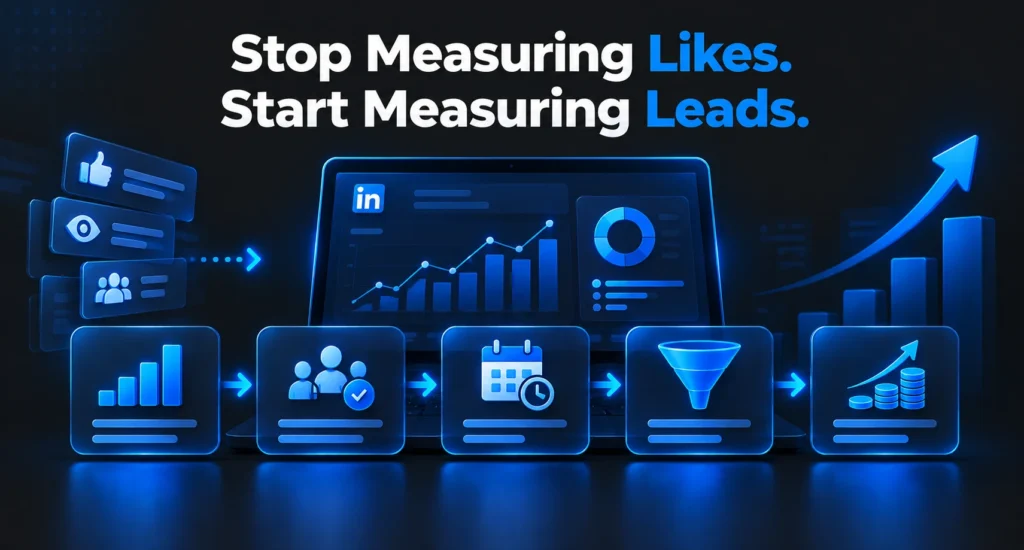
The key is to measure the full journey:
Visibility → Engagement → Profile Visits → Conversations → Qualified Leads → Meetings → Pipeline → Customers
Likes and followers can look impressive, but they don’t tell you whether LinkedIn is helping your startup grow. A strong LinkedIn marketing strategy tracks meaningful actions-from engagement and profile visits to qualified leads, meetings, and pipeline.
| LinkedIn Marketing Metric | What It Tells You | What to Look For |
| Profile Views | Shows whether your content and personal branding on LinkedIn are creating enough interest for people to learn more about you. | Increasing views from your target audience, decision-makers, and potential customers. |
| Relevant Followers | Measures whether you’re attracting the right audience rather than simply growing follower numbers. | Followers who match your Ideal Customer Profile (ICP). |
| Post Impressions | Shows how many times your LinkedIn content has been displayed. | Consistent reach among your target audience, not just high numbers from irrelevant viewers. |
| Engagement Rate | Helps you understand whether people find your content useful or interesting. | Meaningful reactions, comments, shares, and saves from relevant professionals. |
| Comments & Conversations | Indicates whether your content is encouraging genuine discussion. | Questions, opinions, and conversations from prospects or industry decision-makers. |
| Connection Acceptance Rate | Measures how relevant your LinkedIn outreach and connection requests are. | A healthy acceptance rate from prospects who fit your ICP. |
| Message Response Rate | Shows whether your LinkedIn messaging and outreach strategy are creating interest. | Genuine replies rather than one-word responses or no response at all. |
| Qualified Conversations | Measures whether LinkedIn activity is reaching people with a real business need. | Conversations with prospects who have relevant problems, authority, or buying intent. |
| Leads Generated | Shows whether your LinkedIn lead generation strategy is producing potential customers. | Leads that match your target market and have genuine interest in your offer. |
| Lead-to-Meeting Rate | Measures how effectively LinkedIn leads move toward a sales conversation. | A growing percentage of qualified leads booking relevant meetings. |
| Website Traffic | Shows how much interest your LinkedIn content and profile are driving to your website. | Traffic from relevant prospects and target accounts rather than just overall visits. |
| LinkedIn Ads Conversion Rate | Helps measure how effectively paid LinkedIn advertising turns clicks or views into leads. | Conversions from your intended audience at an acceptable cost. |
| Cost Per Lead (CPL) | Shows how much you’re spending to generate each LinkedIn lead through paid campaigns. | Lower costs combined with strong lead quality-not cheap but irrelevant leads. |
| Cost Per Qualified Lead | Gives a clearer picture of the efficiency of your B2B lead generation campaigns. | Cost of generating leads that actually fit your ICP and sales criteria. |
| Meetings Booked | Connects LinkedIn marketing activity with a real sales outcome. | Consistent meetings generated from LinkedIn-sourced prospects. |
| Pipeline Generated | Shows how much potential revenue can be linked to LinkedIn marketing efforts. | Growth in qualified opportunities and LinkedIn-attributed pipeline. |
| Customer Acquisition | Measures the ultimate business outcome of your LinkedIn strategy. | Leads and opportunities that convert into paying customers. |
| LinkedIn Marketing ROI | Helps determine whether your overall investment in content, outreach, and LinkedIn Ads is producing business value. | Revenue and pipeline generated compared with marketing costs. |
This helps you move beyond vanity metrics and understand what is actually working in your LinkedIn marketing strategy.
Not sure whether your LinkedIn marketing is actually contributing to growth? Look beyond likes and followers. Marvels Reach can help identify what’s working, where prospects are dropping off, and what your strategy needs to generate more qualified opportunities. Get a clearer direction for your LinkedIn growth. |
A Practical 30-Day LinkedIn Marketing Strategy for Startups
You don’t need to overhaul your entire LinkedIn presence overnight. A focused 30-day LinkedIn marketing strategy can help startups define their audience, improve their profile, test content, start conversations, and identify what actually drives qualified leads.
| Week | Focus | What to Do | Goal |
| Week 1 | Build the Foundation | Define your Ideal Customer Profile (ICP), identify audience pain points, analyze competitors, clarify your value proposition, and optimize your LinkedIn profile and company page. | Create a clear LinkedIn marketing strategy built around the right audience and positioning. |
| Week 2 | Build Your Content Strategy | Define 4–5 LinkedIn content pillars and create posts around customer problems, educational insights, founder stories, industry trends, and case studies. Test different hooks and formats. | Build consistent LinkedIn content marketing that attracts and educates your target audience. |
| Week 3 | Start LinkedIn Outreach | Identify relevant prospects, send personalized connection requests, engage with their content, and start genuine conversations. Avoid immediate sales pitches and focus on relationship building. | Turn relevant connections into meaningful conversations and potential B2B leads. |
| Week 4 | Measure & Optimize | Review impressions, engagement, profile views, connection acceptance, response rates, qualified conversations, and leads. Identify your best-performing topics and refine your outreach. | Turn insights into a stronger LinkedIn lead generation strategy for the next month. |
The goal isn’t to complete a checklist and stop after 30 days. Use the first month to build a foundation, understand your audience, and create a repeatable LinkedIn marketing and lead generation system that can improve over time.
Common LinkedIn Marketing Mistakes Startups Should Avoid
Most LinkedIn marketing mistakes don’t happen because startups aren’t trying. They happen because effort is going in the wrong direction. Avoiding these common mistakes can help you build a stronger LinkedIn presence and generate more relevant B2B leads.
- Posting Without a Clear Strategy: Posting just to stay active can lead to random content and inconsistent results. Build a LinkedIn content strategy around your audience, goals, and customer pain points.
- Focusing Only on Followers: A large follower count doesn’t guarantee business growth. Focus on attracting the right audience, decision-makers, qualified conversations, and potential leads.
- Talking Only About Your Company: Constant product updates and company announcements can quickly feel promotional. Follow a customer-first content strategy that addresses problems, questions, insights, and industry trends.
- Sending Generic Connection Requests: Copy-paste messages rarely create meaningful conversations. Use personalized LinkedIn outreach based on the prospect’s role, company, interests, or business challenges.
- Pitching Too Early: A new connection isn’t automatically a sales opportunity. Build familiarity first, understand the prospect’s needs, and introduce your solution when there’s a relevant reason.
- Ignoring the Founder’s Profile: Relying only on the company page can limit your reach and credibility. Founder personal branding can help bring expertise, personality, and trust into your LinkedIn marketing.
- Posting Inconsistently: Publishing five posts one week and disappearing for the next month makes it difficult to build momentum. Maintain a realistic LinkedIn posting schedule you can sustain.
- Publishing Generic AI Content: AI can speed up content creation, but generic posts can make your brand sound like everyone else. Add real experiences, original insights, data, and a human voice.
- Running LinkedIn Ads Too Early: Paid campaigns can’t fix unclear messaging or weak targeting. First validate your ICP, offer, content, and conversion process before increasing your advertising spend.
- Not Tracking Lead Quality: Impressions and likes don’t tell the complete story. Track qualified leads, conversations, meetings, pipeline, conversion rates, and LinkedIn marketing ROI to understand actual business impact.
- Expecting Immediate Results: LinkedIn lead generation is often a process of building visibility, trust, and relationships. Give your strategy enough time to gather data, learn what works, and improve.
How Marvels Reach Can Help Startups Build a LinkedIn Lead Generation System
The biggest takeaway from this guide is simple: LinkedIn lead generation isn’t about posting more-it’s about having the right strategy behind every post, connection, and conversation. That’s where professional expertise can make the difference.
At Marvels Reach, we help startups build a tailored LinkedIn marketing strategy around their audience, goals, positioning, and growth stage. From LinkedIn content strategy and founder personal branding to LinkedIn outreach, lead generation, and paid campaigns, our approach focuses on building a system rather than using one-size-fits-all tactics.
Our team combines content, SEO, social media, audience research, and LinkedIn marketing expertise to create strategies that are practical and aligned with business goals. We also focus on consistent execution, so startups don’t have to choose between running their business and managing LinkedIn every day.
The goal isn’t simply to make your LinkedIn profile look active. It’s to make your LinkedIn presence work harder for your business. Whether you need to build visibility, strengthen authority, or create a more consistent pipeline of qualified leads, Marvels Reach can help you build a strategy around what your business actually needs.
Final Thoughts
If there’s one thing to take away from this guide, it’s that LinkedIn marketing for startups isn’t about being everywhere-it’s about being relevant to the right people. Random posts, generic outreach, and chasing likes won’t build a predictable lead pipeline.
Start with your Ideal Customer Profile (ICP), understand your audience’s pain points, optimize your LinkedIn profile, and create content that genuinely helps. Then combine consistent LinkedIn content marketing, personalized outreach, founder personal branding, and performance tracking to turn visibility into meaningful conversations.
You don’t need to implement everything at once. Start with one clear audience, test what resonates, measure the results, and improve your strategy every month.
And if managing all of this yourself feels overwhelming, Marvels Reach can help. Our tailored LinkedIn marketing and lead generation services are designed around your goals, audience, and growth stage.
Ready to make LinkedIn work harder for your startup? Connect with Marvels Reach and start building a strategy that turns attention into opportunities.